4.9 Star Google Rating




Daikin
Every Daikin fault code explained by section, with what each one points to and what to check before you call. Skycon Air diagnoses and repairs Daikin systems across Sydney.
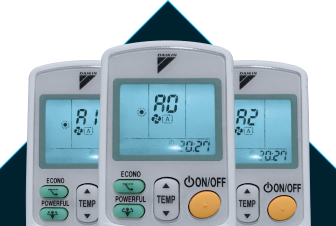
Daikin air conditioning units utilize error codes to indicate specific malfunctions or issues. Below is a list
of common error codes along with their descriptions:
High pressure control in heating or freeze-up protection in cooling.
For a comprehensive list of error codes and detailed troubleshooting steps, please refer to Daikin’s official error code search tool:
daikin.com
If you encounter any of these error codes, it’s recommended to contact a certified Daikin technician for accurate diagnosis and repair.
Every Daikin code starts with a letter, and that letter tells you which part of the system raised the alarm before you test anything. Read the letter first, then the number.
| Letter | What section it covers | What it usually points to |
|---|---|---|
| A | Indoor unit | Board, fan motor, drain, swing motor or expansion valve inside the head |
| C | Indoor sensors | Thermistors reading the coil or the return air |
| E | Outdoor unit | Pressure switches, compressor protection, outdoor fan, outdoor board |
| F | Outdoor temperature | Discharge pipe temperature, the hottest point in the circuit |
| H | Outdoor sensors | Outdoor air thermistor |
| U | System level | Communication between indoor and outdoor, or supply voltage |
The indoor unit cannot talk to the outdoor unit. On a split system that is often the interconnecting cable, a loose terminal or a damaged connector rather than a failed board. On a multi split or ducted system it can also be a single branch, which is why we test each indoor unit individually before condemning anything. Do not replace a board on a U4 until the wiring has been tested.
Daikin identified a low charge, which means a leak exists somewhere. Topping up the gas without finding the leak is a temporary fix that vents refrigerant and returns the same fault within a season. Pressure test first, repair, then charge to the manufacturer specification.
These are compressor protection codes and they are the ones people fear. They can be caused by a failing capacitor, a seized compressor, a restricted refrigerant circuit or a supply voltage problem. Test the capacitor and windings before quoting a compressor, because the cheap part is the more common failure.
Do not clear a code repeatedly to keep the system running. Do not bypass a pressure switch. Do not add refrigerant without a leak test, and do not open the outdoor electrical panel unless you are licensed, because the capacitor holds a charge after the isolator is off.
Tell us the code, the model number from the sticker on the indoor unit, and what the system was doing when it stopped. We carry the common Daikin parts for these codes, which usually means one visit instead of two. For the repair itself see air conditioning repairs Sydney, and for the brand overview see Daikin air conditioning Sydney. If you are comparing your options, start with air conditioning in Sydney.
Most Daikin wall controllers display it directly as two characters, sometimes with a flashing icon. If you have a simpler remote, the indoor unit may flash a sequence of LED blinks instead. On ducted systems the code usually appears on the wall controller, and on some models the outdoor board shows its own LED pattern.
Older Daikin controllers show faults as blink counts. Count how many times the LED flashes, pause, then repeat the count, and note whether there are long and short groups. That pattern maps to the same code table, and quoting the blink count is just as useful to us as quoting a code.
Yes, once. Turn the system off at the isolator or the breaker for a few minutes, then back on. If the code clears and the unit runs normally, you had a transient fault. If it returns within minutes, it is a live fault and repeated resets will not help and may do damage.
Because peak heat exposes weakness. Low refrigerant, a fouled outdoor coil or a tired fan cannot reject enough heat at 40 degrees, so protection circuits trip. The system may run perfectly all winter and fail on the first hot week, which is why servicing before summer catches these faults while parts and technicians are available.
No. Plenty are minor, such as a blocked drain or a dirty filter causing a freeze-up. Others, like E5, E6 or U0, are more serious and should not be ignored. The code tells you where to look, not how bad it is. That is what the diagnosis determines.
U4 is a transmission failure, meaning the indoor and outdoor units cannot communicate, which is usually a wiring or connector fault. UA means the indoor and outdoor units are an incompatible combination, which is an installation problem rather than a failure. UA typically appears on a system where mismatched equipment was paired.
Broadly yes across the residential range, with some variation by model generation and by whether it is a split, multi split or ducted system. VRV systems have additional codes of their own. If your code is not in the list above, give us the model number and we will identify it against the Daikin tables.
Regularly. A blocked filter restricts airflow, the indoor coil drops below freezing, and freeze-up protection shuts the system down. It is the most common cause of a cooling complaint that looks like a major fault and is fixed by cleaning. Check and clean filters monthly through summer.
Some do, particularly voltage and communication faults that resolve when conditions change. If a code appears and then disappears without you doing anything, note the date and the weather. Repeat appearances of the same code are worth investigating even if the system seems fine between them.
A licensed technician, and the work needs to be traceable for the warranty to hold. Keep your service records, because Daikin can ask for evidence of regular servicing on a compressor claim. If your system is still under manufacturer warranty, tell us when you book so we handle it appropriately.