4.9 Star Google Rating




A Guide To
Every major brand's fault codes explained, with what each one means and what to check before you call. Skycon Air diagnoses and repairs error codes across Sydney for homes and commercial sites.
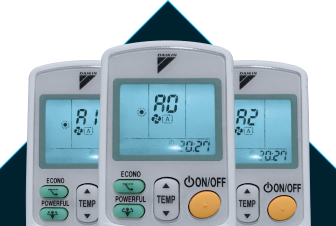
An error code is not a fault. It is the system telling you it has shut itself down to protect the compressor, and recording the reason so a technician does not have to guess. Every brand uses a different letter and number scheme, which is why the same two characters can mean a blocked drain on one unit and a refrigerant loss on another. Start with the brand, then the code, then the symptom you actually noticed.
| Where to look | What it looks like | What to note down |
|---|---|---|
| Wall controller or remote | Two characters flashing, sometimes with a small spanner icon | The exact code, and whether it clears after a restart |
| Indoor unit LED | A pattern of blinks on the front panel | How many blinks, and how many times the sequence repeats |
| Outdoor unit board | A small red or green LED on the control board | The blink count, if you can safely open the service panel |
| No code at all | Unit simply stops | What it was doing at the time, and how long it ran before stopping |
Three things are worth checking before you call, because they are free and they are common. Filters, which restrict airflow and cause freeze-up codes. The outdoor unit, which needs clear airflow and no leaves or debris against the coil. The condensate drain, which blocks and causes water codes. Anything beyond that means opening an electrical panel or touching refrigerant, and both are licensed work in New South Wales.
| What you see | What to do |
|---|---|
| Burning smell, smoke, or scorch marks | Isolate power at the breaker. Do not restart. Call immediately. |
| Water running near electrical fittings or into a ceiling | Switch off at the isolator and call. This is property damage, not just comfort. |
| Safety switch trips every time the unit starts | Leave it off. Do not keep resetting the breaker. |
| Outdoor unit ice cold with visible frost on pipework | Stop using it. Continuing to run a flooded system can damage the compressor. |
| Code present but system still running normally | Note the code and book a service. Not urgent tonight. |
Pick your brand below and find the exact code. Each library breaks codes into indoor, outdoor and system faults, because that distinction often points at the component before anyone opens a panel. If your brand is not listed, call us with the model number from the indoor unit sticker and the code, and we will identify it.
Daikin error codes, Mitsubishi Electric error codes, Fujitsu error codes, Samsung error codes, LG error codes, Hisense error codes, Haier error codes, Hitachi error codes, Carrier error codes, Toshiba error codes, Rinnai error codes and ActronAir error codes.
Codes are manufacturer shorthand, not an industry standard. Daikin uses A and C series codes for indoor faults and U series for system faults. Mitsubishi Electric runs a P series for indoor and U series for outdoor. Samsung uses digits followed by E. LG uses CH for indoor. F3 means a discharge pipe temperature fault on a Daikin and an overvoltage supply fault on a Rinnai. This is exactly why looking up the wrong brand sends you after the wrong part.
For the repair itself, see air conditioning repairs Sydney. For the bigger picture on systems, start with air conditioning in Sydney or our commercial air conditioning service.
It means the system detected a condition outside its safe operating range and shut down to protect the compressor. The code identifies which circuit or sensor raised the alarm, not necessarily the failed part. That is why a technician tests before replacing anything, because the same code can be caused by a cheap filter or an expensive board.
You can usually reset once by turning the unit off at the isolator for a few minutes and back on. If the code clears and stays clear, you had a transient fault, often a power dip. If it returns within minutes, it is a live fault and resetting it repeatedly will not help and may cause damage.
On some systems, yes. Older and cheaper units use blinking LEDs instead of a display, and a few show nothing at all. In that case the symptom becomes the diagnostic: what it was doing, how long it ran, whether it trips the safety switch, and whether it still responds to the remote. Write those down before you call.
No, and this is where people lose money. A drainage code is often a blocked drain line. A freeze-up code is often restricted airflow from a dirty filter. An overcurrent code can be a failing capacitor rather than a compressor. A proper diagnosis tests the circuit in sequence instead of reading the code and ordering the part it suggests.
Peak demand exposes weakness. Low refrigerant, a fouled outdoor coil or a struggling fan shows up on the first 40 degree day because the system cannot reject enough heat. That is why air conditioning fails so often in the first week of summer and why servicing before the season matters more than servicing after.
Voltage spikes and dips trip protection circuits, and some codes are literally voltage faults. Daikin U2 and Rinnai F3 both relate to supply quality. If a code appears after a storm, note it and mention the timing. If it keeps happening, the supply itself may need checking by an electrician.
Not if the code returns after a reset. The system has told you it is protecting itself, and overriding that repeatedly is how a repairable fault becomes a compressor replacement. If it is cooling normally and the code is intermittent, book a service rather than an emergency call.
We quote before work starts, and the diagnosis is what you are paying for, not the code lookup. A technician who arrives already knowing your brand and code saves time on site. Send us the code and model number when you book and we will bring the likely parts, which usually avoids a second visit.
Regularly. Restricted airflow drops the coil temperature until it ices over, which triggers freeze-up protection on almost every brand. It also reduces cooling and forces the compressor to run longer. Cleaning filters monthly during summer is the cheapest fault prevention there is, and it costs nothing.
The brand, the model number from the sticker on the indoor unit, the exact code, and what you noticed before it appeared. Add whether the safety switch tripped, whether water or ice is visible, and how long the system ran before stopping. That information turns a diagnostic visit into a repair visit.