4.9 Star Google Rating



 Skip to main content
Expert
At Skycon Air, we specialise in the design and installation of fabric duct systems that provide efficient, even, and reliable air distribution for commercial and industrial spaces across Sydney. Fabric ducting offers a lightweight, cost-effective, and visually appealing solution that enhances indoor comfort while improving air quality and energy efficiency.
Commercial
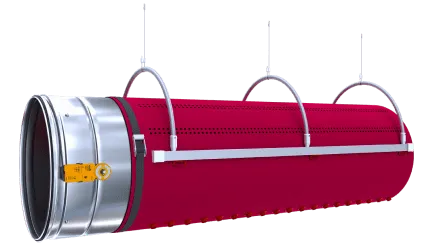
At Skycon Air, we specialise in providing high-quality fabric ductwork and fabric ducting systems across Sydney, NSW. Designed as a modern alternative to traditional metal ducting, fabric ducts offer exceptional performance, durability, and style. They are lightweight, easy to install, and deliver consistent airflow, making them an ideal choice for commercial, industrial, and retail environments.
Our fabric ducting systems are engineered to evenly distribute air, ensuring comfort while reducing drafts and energy consumption. They are also highly versatile and can be customised to suit a wide range of applications, from offices and warehouses to gyms, restaurants, and cleanrooms. Available in multiple colours and finishes, they can seamlessly integrate with your building’s design while enhancing its aesthetic appeal.
In addition to performance, Skycon Air’s fabric ductwork solutions are practical and hygienic. The fabric material is resistant to condensation, mould, and dust build-up, ensuring a cleaner and healthier indoor environment. Easy to clean and maintain, they offer long-term value and cost savings.
For businesses and property owners in Sydney, choosing Skycon Air conditioning Sydney means investing in a reliable, energy-efficient, and sustainable ducting solution tailored to your needs.
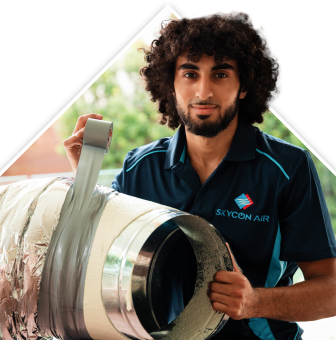

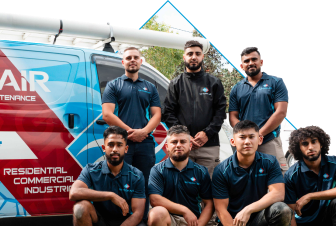
Skycon Air brings proven experience in designing and installing fabric duct systems for diverse industries. Our team understands airflow dynamics and compliance standards, ensuring each system delivers consistent performance, efficiency, and reliability tailored to your business needs across Sydney.
Every space distributes air differently. Skycon Air designs each fabric duct layout around the geometry of the room, the occupancy and the air volume required, so delivery stays even from one end of the run to the other. Fabric specification, nozzle arrangement and suspension all follow from that design rather than from a standard package.
We use premium-grade fabric materials and advanced technology to guarantee durability and long-lasting performance. Our fabric duct systems are lightweight, easy to maintain, and resistant to wear, providing a practical and cost-effective alternative to traditional ducting systems.
Skycon Air offers complete service, from consultation and system design to installation and ongoing maintenance. Our team ensures timely delivery, transparent communication, and continued support, making us a trusted partner for reliable ventilation solutions in Sydney.
Textile duct does something metal duct cannot. Instead of pushing air out of a handful of grilles, it releases air along its entire length through a permeable surface, so a large space gets air everywhere at once rather than in jets. That is why fabric systems suit gyms, warehouses, food production, showrooms and any space where people or product cannot sit in a draught. We design and install fabric duct systems across Sydney, and we are honest when conventional duct is the better answer.
The fabric is engineered with a specific permeability, so air passes through the wall of the duct as well as out of nozzles or perforations. The result is low velocity delivery spread across a huge surface area. It is quiet, it avoids stratification in tall spaces, and it distributes without the cold spots that come from a few high velocity diffusers. Being lightweight, it also needs far less structural support than spiral duct.
| Application | Why fabric duct fits | What to watch |
|---|---|---|
| Gyms and sports halls | Draught free at occupant level across a big volume | Washability matters, so specify a launderable system |
| Warehouses and distribution | Even coverage over long spans with minimal structure | Suspension height and access for cleaning |
| Food production and packaging | Hygienic, washable, no condensation drips | Correct fabric specification for the environment |
| Showrooms and retail | Quiet and visually tidy when specified well | Colour and appearance become a design decision |
| Commercial kitchens or greasy air | Usually not suitable | Grease loading is a job for metal duct and filtration |
How the duct is aimed decides whether it heats, cools or ventilates effectively. Cooling wants high level delivery so cold air falls through the space. Heating wants low level delivery so warm air rises through the occupied zone. Get the orientation wrong and a good product performs badly.
Fabric duct needs to hang straight and stay tensioned, which means the suspension system and the available structure matter as much as the duct itself. Long runs need intermediate support and the right amount of tension at each end, otherwise the run sags and the air pattern changes.
Most systems are launderable or cleanable, but the interval depends on the environment. A gym or a food facility needs a different cleaning regime to a showroom. We specify with cleaning in mind, because a fabric system that cannot be cleaned properly becomes a hygiene problem rather than a feature.
Fabric systems install fast, which is one of their practical advantages on a tight programme. That speed only pays off if the suspension points are set out correctly and the airflow is balanced at commissioning. We check delivery pattern across the space rather than just at the inlet, because the whole point of fabric duct is what happens along the length. Compare mechanical ventilation systems for the building wide design, or exhaust fan installation where extraction is the main job. We also deliver commercial ventilation alongside commercial air conditioning Sydney and construction air conditioning Sydney, with everything linking back to air conditioning in Sydney.
What builders, facility managers and designers ask us about textile duct.
It is a duct made from engineered textile rather than metal. Air passes through the permeable fabric wall as well as through nozzles or perforations, so delivery is spread along the whole length at low velocity. That produces even conditions in a large space without the draught you get from a few high velocity metal diffusers.